
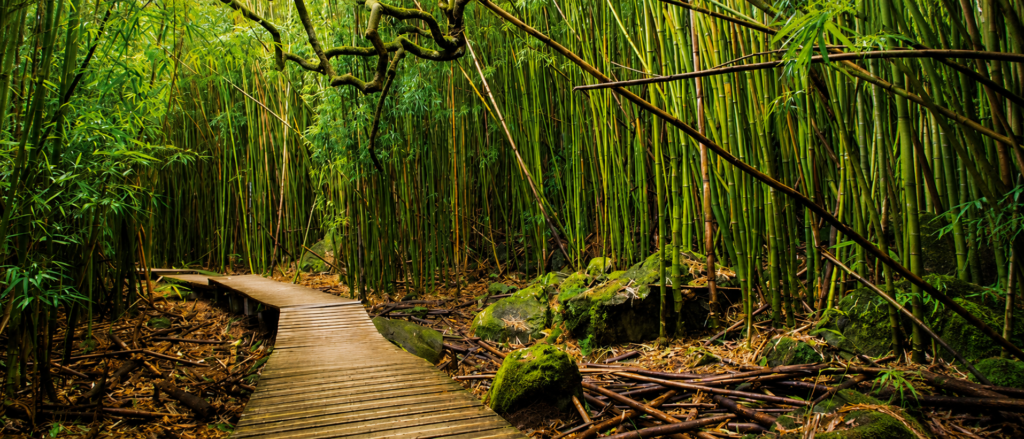
Bamboo forest Maui Pipiwai Trail
The Road to Hana needs an entire day of your Maui vacation. You’ll navigate 600 curves and cross 54 bridges along the eastern coastline, and if you’re going to commit that much time and energy, you need to push beyond Hana town to reach the bamboo forest that makes the whole experience worthwhile.
Most visitors treat the drive like a checklist, stopping at every waterfall and fruit stand, then turning around at Hana because they’re exhausted. The real highlight sits about 10 miles beyond Hana, where the Pipiwai Trail winds through one of the most surreal bamboo forests you’ll ever see before delivering you to a 400-foot waterfall that dwarfs everything else you encountered earlier in the day.
The bamboo forest serves as the grand finale. The dense jungle closes in around you while the boardwalk carries you through towering green stalks that creak and sway in the wind like a living instrument.
Getting there needs more planning, better timing, and honestly, a lot more endurance than most casual Road to Hana guides let on.
Understanding the Two Different Bamboo Forests
When people talk about “the bamboo forest on the Road to Hana,” they’re usually referring to two completely different places. Mixing them up can turn your day from magical to genuinely risky.
The official, well-maintained bamboo forest experience happens on the Pipiwai Trail inside Haleakalā National Park’s Kipahulu District, near mile marker 42 beyond Hana town. This location features boardwalks, proper signage, park rangers, and a clear 4-mile round-trip route that takes you past Makahiku Falls, through dense bamboo groves, and ultimately to Waimoku Falls.
This is the one you want.
An unofficial “Bamboo Forest Trail” also exists near mile marker 6.5 on the Hana Highway itself, accessed from a small, unmarked pull-off across from some tall pine trees. This trail sounds adventurous in theory, with its many waterfalls, rope sections, and ladder climbs.
In practice, the trail is muddy, steep, poorly marked, and responsible for a lot of rescues and injuries.
People have been airlifted out after ankle injuries and flash-flood incidents.
If you’re booking a private Road to Hana tour, make sure your guide knows which bamboo forest you’re targeting. A good guide will steer you straight to the Pipiwai Trail and skip the roadside sketchy option entirely, especially if you’re traveling with family or anyone who isn’t an experienced hiker.
Planning Your Route and Timing
Getting to the Pipiwai Trail from Kahului or most central Maui resorts takes about 2.5 to 3 hours of driving time before you factor in stops. The Hana Highway is narrow, winding, and slow.
There’s really no way around it.
You’ll be doing 15 to 25 miles per hour through most of the curvy sections, and you’ll encounter one-lane bridges where you need to yield to oncoming traffic. Expect to spend significantly more time than your GPS initially suggests.
You have two main route options. The traditional Hana Highway (HI-360) offers the classic scenic route with ocean views, waterfalls, and plenty of photo-worthy stops.
The road is beautiful, but crowded and can feel exhausting by the time you reach Hana itself.
The choice is the backside Piʻilani Highway route, sometimes called “the road less traveled.” This approach comes in from the opposite direction and can shave about 30 minutes off your drive time. The route is more remote, more exposed, and has fewer services, but if your main goal is the bamboo forest and you don’t need to hit every single waterfall along the way, this choice actually makes a lot of sense.
For a bamboo-forest-focused day, you’re looking at a 10 to 12 hour commitment from start to finish. Most private tours that center the experience around the Pipiwai hike will recommend an early departure, around 7:30 or 8:00 am, to beat traffic, secure parking at the Kipahulu Visitor Center, and give you plenty of daylight for the hike itself.
The hike typically takes 2.5 to 4 hours depending on your pace and how long you linger at the waterfalls.
National Park Fees and the Three-Day Pass Strategy
The Kipahulu District of Haleakalā National Park charges an entrance fee of about $30 per vehicle, and that pass is valid for three consecutive days. This creates an interesting planning opportunity because that same pass also covers entry to the Haleakalā summit area.
You can hike the bamboo forest on one day, then use the same pass to catch sunrise or sunset at the Haleakalā crater on a different day within that three-day window. This multi-experience strategy turns one park fee into two completely distinct adventures, and a lot of visitors don’t realize this option until after they’ve already paid twice.
If you’re working with a private tour company that really knows Maui, they can help you structure a multi-day itinerary around this pass. Bamboo forest and waterfalls on day one, summit sunrise on day two, and suddenly you’ve experienced two of Maui’s most memorable landscapes for the price of one entrance fee.
What the Pipiwai Trail Actually Feels Like
From the Kipahulu Visitor Center parking lot, the trail starts on a well-signed path that quickly immerses you in rainforest scenery. Within the first half mile, you’ll reach the Makahiku Falls overlook, which gives you a solid early payoff: a wide, dramatic waterfall cascading down a cliff face into a pool below.
From there, the trail continues deeper into the forest, crossing streams on sturdy bridges and gradually gaining elevation. The terrain mixes dirt, rock, and wooden steps, and while people consider it “moderate” in difficulty, that 800 feet of elevation gain will be felt, especially in the humidity.
You’ll notice your heart rate increasing and your breathing getting heavier as you climb.
Then you hit the bamboo forest section, and things start to change for the better. The trail transitions onto wooden boardwalks, and suddenly towering bamboo stalks surround you so densely that the canopy overhead filters the light into soft green hues.
The stalks creak and knock together in the wind, creating this eerie, almost musical sound that makes the whole experience feel otherworldly.
The boardwalks can be slippery when wet, so you need to watch your footing carefully, but they protect the fragile root systems and keep hikers on a defined path through the grove. The bamboo section stretches for maybe a quarter mile, and everyone remembers this part.
This is what shows up in all the photos and makes the whole hike worth the effort.
Beyond the bamboo, the trail continues through more rainforest before finally opening up at Waimoku Falls, a towering 400-foot waterfall that spills down a sheer rock face. You can’t get super close to the base because of rockfall danger, but the viewing area gives you a powerful sense of scale.
This waterfall serves as the natural endpoint of the hike.
Common Mistakes and How to Avoid Them
One of the biggest mistakes people make is underestimating how long the full Road to Hana plus bamboo forest hike actually takes. A lot of visitors start the drive without a clear plan, stop at every single roadside waterfall and fruit stand along the way, and then arrive at the Kipahulu trailhead at 3:00 or 4:00 in the afternoon.
By that point, they’re racing daylight, already tired from hours of driving, and often end up skipping the hike entirely or turning around partway through. I’ve seen countless frustrated tourists realize too late that they’ve run out of time for what they actually came to see.
If the bamboo forest is your priority, you need to structure the day around it. That means leaving early, being selective about which stops you make on the drive, and arriving at the trailhead by early to mid-afternoon at the latest.
Some visitors even choose to skip most of the early Highway stops and save them for the return drive, when they’re not worried about losing daylight.
Another common issue is footwear. The trail is well-maintained, but it’s also humid, muddy in sections, and involves stream crossings and slippery boardwalks.
Running shoes are okay if they have decent tread, but flip-flops or sandals are a terrible idea.
You want closed-toe shoes with grip. Lightweight hiking shoes or trail runners are ideal.
Weather is another factor that catches people off guard. The Kipahulu area is one of the wettest parts of Maui, and rain can roll in quickly.
Flash floods are a real risk, especially in streambeds and near waterfalls.
If the forecast shows heavy rain or if you see storm clouds building, reconsider the hike entirely. The park posts advisories when conditions are dangerous, and you should absolutely take those seriously.
Parking at the Kipahulu Visitor Center can also fill up during peak season, especially late morning through early afternoon. Arriving early or later in the day gives you better odds of snagging a spot without circling the lot or parking unsafely along the roadside.
Adapting the Experience for Different Types of Travelers
The Pipiwai Trail is family-friendly in the sense that kids can absolutely finish it, but you need to be realistic about your group’s fitness level and attention span. Four miles round-trip with elevation gain and stream crossings is more than a casual stroll, and younger kids or older relatives who aren’t used to hiking might struggle.
For families with young children, breaking the hike into manageable goals works well. Make it to Makahiku Falls, take a break, reassess.
Push to the bamboo forest, enjoy the boardwalk section, then decide whether to continue to Waimoku Falls or turn back.
The bamboo itself is the most memorable part for a lot of kids anyway, so you don’t necessarily need to finish the full trail to have a great experience.
Photographers will want to budget extra time. The bamboo forest is absolutely stunning, but capturing it well needs patience.
The light filtering through the canopy changes constantly, and you’ll want to experiment with angles, exposure, and composition.
Bringing a tripod is tempting, but keep in mind that the boardwalks are narrow and crowded during peak hours, and you don’t want to be the person blocking traffic for minutes at a time to get the perfect shot.
If you’re on a cruise ship stop with limited time, the full Road to Hana loop plus Pipiwai hike is honestly pushing it. You’d need at least 10 to 12 hours to do it comfortably, and most cruise excursions don’t give you that kind of window.
In that case, either book a private tour designed specifically for cruise passengers that knows how to time everything perfectly, or consider the shorter “Halfway to Hana” tour option that focuses on waterfalls and coastal stops without pushing all the way to the bamboo forest.
Why a Private Tour Can Make or Break the Day
Driving the Road to Hana yourself is totally doable, but it’s also exhausting. You’re navigating narrow roads with blind curves, watching for oncoming traffic on one-lane bridges, trying to spot unmarked trailheads, dealing with limited cell service for navigation, and managing the mental fatigue that comes with hours of slow, focused driving.
A private Road to Hana tour takes all of that off your plate. Your guide handles the driving, knows exactly where to stop and for how long, understands current trail conditions and closures, and can time the day around weather and crowds.
For a bamboo-forest-focused experience, some tour companies even design custom itineraries where the Pipiwai hike is the centerpiece as opposed to just one of many quick stops.
The other advantage of a private tour is local knowledge. Your guide can explain the difference between native and invasive plant species in the bamboo forest, share stories about the history of the Kipahulu area, and steer you toward lesser-known viewpoints that don’t show up in guidebooks.
They’ll also know which roadside fruit stands are worth stopping at and which ones to skip.
Safety and Environmental Responsibility
Staying on the designated trail is non-negotiable, both for your safety and for protecting the fragile ecosystem. The bamboo root systems are shallow and easily damaged, and wandering off the boardwalk to get a better photo or explore a side path can cause lasting harm.
Flash floods are the most serious safety risk on the Pipiwai Trail. The park posts warning signs at the trailhead, and you should take them seriously.
If you see heavy rain upstream, hear a sudden roar in a streambed, or notice water levels rising quickly, get to high ground immediately and consider turning back.
People have been swept away in Hawaiian stream flash floods, and it happens faster than you’d expect.
Leave-no-trace principles apply here just as much as anywhere else. Pack out everything you bring in, don’t litter, and resist the urge to stack rocks or carve initials into bamboo stalks.
The park is managing increasing visitor numbers, and every little bit of impact adds up.
Respecting Hawaiian cultural sites is also important. The Kipahulu area has deep cultural significance, and while the Pipiwai Trail itself is a designated visitor route, the surrounding landscape is part of a larger place that holds meaning beyond tourism.
Approach it with respect, keep noise levels down, and remember that you’re a guest in a place that people call home.
Building Your Bamboo Forest Day Into a Larger Maui Itinerary
Because the Road to Hana and Pipiwai hike take up an entire day, you’ll want to think about how this fits into the rest of your Maui trip. If you’re staying in Wailea or Kihei, the drive to the starting point is longer, so an overnight in Hana or Paia the night before can make the logistics easier.
Using that three-day national park pass strategically means you can mix the bamboo forest experience with a separate Haleakalā summit visit. Sunrise at the crater needs advance reservations and an ungodly early wake-up call, but seeing it is one of the most memorable experiences on Maui.
Pairing it with the bamboo forest hike within the same three-day window makes both feel like parts of a cohesive Maui adventure as opposed to disconnected activities.
Some travelers also use the backside Piʻilani Highway route to create a loop as opposed to backtracking along the same road. This gives you different scenery on the return drive and breaks up the monotony, though you should be aware that the backside route is more remote, has fewer services, and can feel more exposed if weather turns bad.
How long does the Pipiwai Trail take to hike?
The Pipiwai Trail is 4 miles round-trip and typically takes between 2.5 to 4 hours to finish, depending on your pace and how much time you spend at the waterfalls and in the bamboo forest. If you’re hiking with kids or stopping often for photos, plan for the longer end of that time range.
Can you see the bamboo forest without doing the full hike?
The bamboo forest section sits roughly halfway through the Pipiwai Trail, about 1.5 to 2 miles from the trailhead. You can hike just to the bamboo forest and turn around without going all the way to Waimoku Falls, which cuts the total hiking time roughly in half while still giving you the most memorable part of the experience.
Is the Road to Hana worth it just for the bamboo forest?
Yes, the Pipiwai Trail bamboo forest and Waimoku Falls are worth the drive. However, you need to structure your day specifically around reaching the trail, which means leaving early and being selective about stops along the way.
Many people make the mistake of treating the bamboo forest as just another stop on an already packed itinerary and run out of time or energy.
What is the best time of day to hike Pipiwai Trail?
Early to mid-afternoon is the ideal window for starting the Pipiwai Trail. This gives you plenty of daylight to finish the hike while also allowing time for the drive from central Maui.
Starting too late in the day means you’ll be racing sunset, while arriving too early might mean dealing with morning rain, which is common in this wet area.
Do you need hiking experience for the Pipiwai Trail?
The Pipiwai Trail is considered moderate difficulty and doesn’t need advanced hiking experience, but you do need to be reasonably fit. The trail includes 800 feet of elevation gain, stream crossings, and can be muddy and slippery.
Anyone who can handle a few miles of walking with some uphill sections should be fine.
Is the backside road to Hana dangerous?
The backside Piʻilani Highway route is more remote and exposed than the traditional Hana Highway, but calling it dangerous is an overstatement. The road is paved and maintained, though it has fewer guardrails and services.
Rental car companies sometimes restrict driving on this section, so check your agreement before planning this route.
Can you drive the Road to Hana in a rental car?
Yes, you can drive the Road to Hana in a standard rental car. You don’t need a four-wheel drive vehicle for the traditional Hana Highway or for the paved sections of the backside route.
However, some rental companies ban driving on certain sections of the backside road, so verify your rental agreement before committing to that route.
How much does it cost to visit the bamboo forest?
The Kipahulu District of Haleakalā National Park charges about $30 per vehicle for entry, and this fee includes access to the Pipiwai Trail and bamboo forest. The pass is valid for three consecutive days and also covers the Haleakalā summit area, so you can visit both locations with one entrance fee.
Are there bathrooms on the Pipiwai Trail?
Restrooms are located at the Kipahulu Visitor Center parking area before you start the Pipiwai Trail. There are no bathrooms along the trail itself, so use the facilities before you begin your hike.
The hike takes several hours, so plan accordingly.
What should you wear to hike the bamboo forest?
Wear closed-toe shoes with good tread, like hiking shoes or trail runners. The boardwalks in the bamboo forest can be slippery when wet, and the trail includes muddy sections and stream crossings.
Bring layers because the temperature and sun exposure change throughout the hike, and consider a light rain jacket since the area receives frequent rainfall.