
The Real Guide to Choosing the Best Maui Family Resort
They want to know which resort is “best,” when what they really need to understand is which resort matches their actual family situation, not some idealized version of a Hawaiian vacation they saw in a brochure.
A resort with seven waterslides can be a nightmare for parents with a six-month-old. A luxury property with impeccable service might lack the kitchen that makes a week-long stay with toddlers manageable.
And that stunning oceanfront room?
It could be right next to the nightly luau stage, which means your kids won’t sleep past the first evening.
So let me walk you through what actually matters when you’re choosing a Maui family resort, because understanding these details will save you thousands of dollars and prevent what I call “vacation regret,” that sinking feeling when you realize on day two that you’ve booked completely wrong.
Understanding Maui’s Resort Geography
Maui is a collection of distinct resort zones, and where you stay fundamentally shapes your experience. Each area has specific characteristics that affect everything from beach conditions to grocery access to whether you’ll need that rental car every single day.
Wailea sits on the south coast and delivers that polished, manicured luxury vibe. The beaches tend to be calmer here, the properties lean upscale, and you’re really well positioned for South Maui snorkeling and beach access.
The whole area feels refined and intentional, with manicured grounds and that sense that everything has been carefully designed for a premium experience.
Kāʻanapali is where most people picture themselves when they think “Hawaiian beach resort.” Located on the west coast, the area has that classic resort strip energy, and Whalers Village gives you convenient shopping and dining right there. The vibe is more active, more bustling, more immediately recognizable as a vacation destination.
You’ll see more families, more activity, more of that traditional resort atmosphere where everything feels accessible and lively.
Then there’s Kapalua, farther north, quieter, more spread out. It works exceptionally well for families who want scenic beauty and don’t need to walk to twelve restaurants every evening.
The beaches here are gorgeous, the resorts tend to be more intimate, and the whole area has a more relaxed, residential feel.
The trade-off is that you’re less central for island exploration, and winter surf can really limit which beaches are swimmable. When the North Pacific swell picks up between November and March, some of Kapalua’s most beautiful beaches become too rough for swimming, especially with children.
What surprises most families is how much these geographic choices affect daily logistics. You’re not just picking a beach.
You’re choosing your access to groceries, your drive time to Haleakalā, your exposure to crowds, and whether you’ll need a rental car literally every single day.
A family staying in Wailea might make one grocery run and then eat most meals at nearby restaurants or in their room. A family in Kapalua might need to drive to Lahaina or Kāʻanapali for certain supplies or dining variety.
These distances add up over a week, and they affect how much time you spend in the car versus on the beach.
The Space Versus Service Decision
Here’s something that doesn’t get discussed enough in resort reviews: the basic trade-off between hotel service and residential space. A luxury hotel room gives you daily housekeeping, turndown service, concierge support, and that feeling that someone else is managing everything.
But it’s also one room, which means parents are tiptoeing around after bedtime, there’s nowhere to store groceries, and you’re eating every meal out or ordering room service at prices that can exceed your accommodation costs.
A condo or villa flips that equation. You gain a full kitchen, a washer and dryer, separate bedrooms, living areas, and the ability to establish something closer to a normal routine.
What you lose is daily service, that immediate problem-solving support, and sometimes the resort programming that entertains your kids while you catch your breath.
For families with babies or toddlers, the residential option almost always wins. Early wake-ups become easier when you can make coffee without leaving the room.
Your five-month-old wakes up at six, and instead of trying to dress everyone and head to breakfast, you can pour a cup of coffee, sit on the lanai, and let everyone else sleep.
Naps don’t require everyone to sit in silence. Food allergies, bottle preparation, and the sheer volume of stuff that comes with young children, all of this becomes infinitely more manageable with space and appliances.
But if you’ve got school-age kids who want activities, or if you’re on a shorter trip where you value service over cooking, then a full-service resort makes more sense. The key is to actually think through your daily rhythm instead of just booking based on photographs.
Walk through a typical day in your head.
What time does everyone wake up? Who needs coffee immediately?
When do the kids eat breakfast?
Do they eat the same thing, or do you have one who only eats plain scrambled eggs while another wants pancakes? How many outfit changes happen in a day?
How often are you washing sandy towels and swimsuits?
These practical details decide which setup will actually work for your family.
Why Grand Wailea Dominates the Pool Conversation
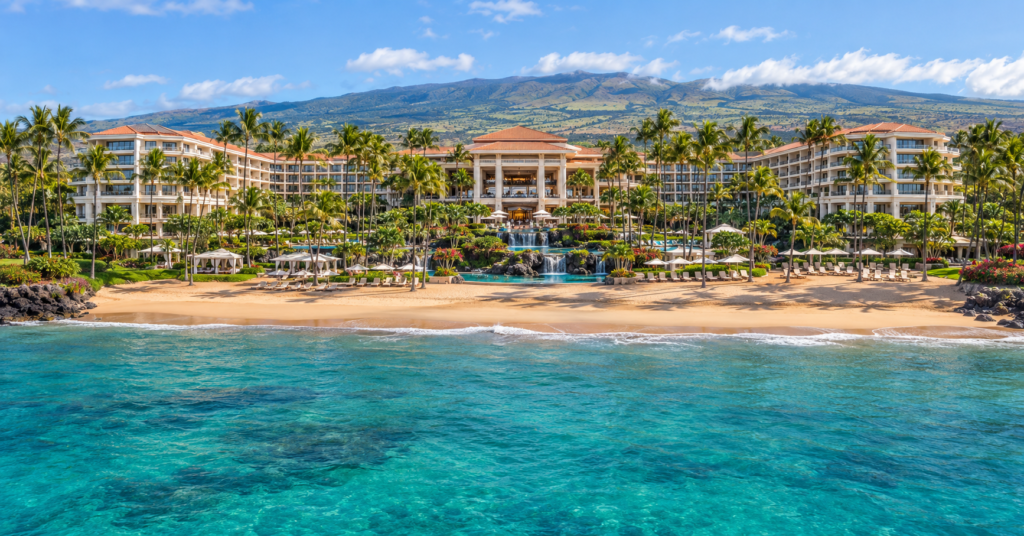
When families research Maui resorts, Grand Wailea shows up constantly, and there’s a really good reason for that. The property has what they call the Wailea Canyon Activity Pool, 25,700 square feet spread across nine pools on six levels, with seven waterslides, a lazy river, waterfalls, caves, a rope swing, and a shallow baby beach area.
The whole thing is genuinely spectacular, not just impressive for Maui, but one of the most elaborate resort pool complexes in the United States.
If your children are between about five and twelve, and pool time is legitimately their primary vacation goal, Grand Wailea delivers in a way that nothing else on the island can match. Kids can spend hours here, moving from slide to slide, floating down the lazy river, jumping off rocks into deep pools, exploring caves with hidden waterfalls.
The variety keeps them engaged in ways that a standard resort pool simply cannot.
The resort also runs a Keiki Club for that exact age group, with half-day sessions that include cultural activities, crafts, and exploration. So you’re not just getting the pools.
You’re getting structured programming designed to keep kids engaged while giving parents legitimate downtime.
That combination of infrastructure and programming is what makes Grand Wailea so dominant in family resort conversations.
But here’s what the marketing materials don’t emphasize. Grand Wailea is expensive.
The daily resort fee is substantial, there’s a separate parking charge, and the property is large enough that your room location really matters.
A room near the pools is incredibly convenient. A room in a distant tower means you’re doing a lot of walking, possibly with a stroller, possibly with tired children who’ve just spent three hours in the water and have zero remaining patience for a ten-minute walk back to your room.
Also, those dramatic slides have height restrictions. A three-year-old might not be able to use the main attractions, which means you’ve paid a premium for infrastructure your child can’t access.
You’re watching from the baby pool while older kids zoom down the slides, and your toddler is frustrated because they can see all this amazing stuff they can’t use yet.
So Grand Wailea is genuinely spectacular for the right family profile: elementary-age kids, budget flexibility, and a plan to spend many full days at the resort. For other family profiles, particularly those with very young children or tight budgets, it’s not automatically the best choice.
Fairmont Kea Lani and the Suite Advantage
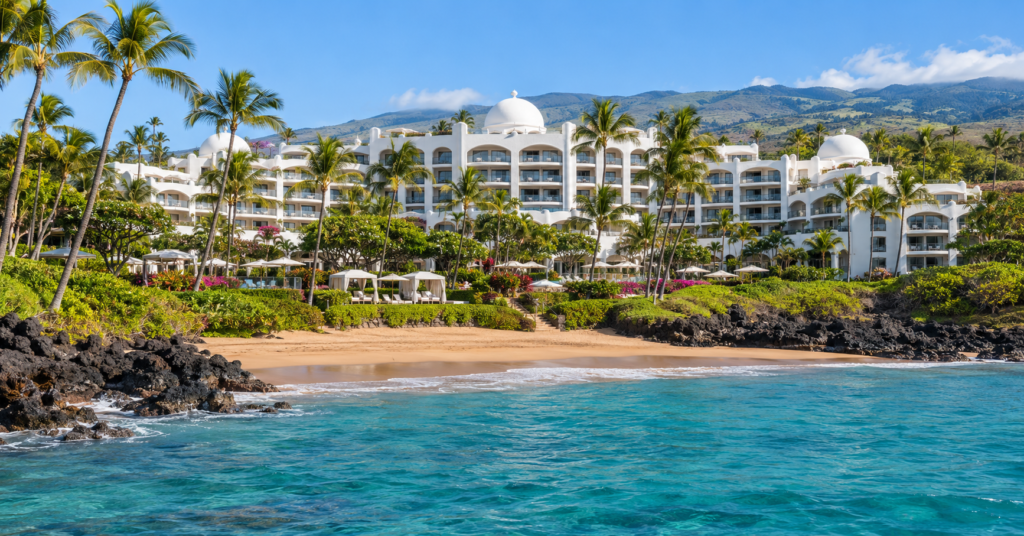
Fairmont Kea Lani approaches family travel from a completely different angle. Instead of building the biggest pool, they made every standard accommodation a suite.
That means separate living areas, more bathroom space, better storage, and actual doors that close between sleeping zones.
This design is transformative if you’ve got an infant who goes to bed at seven or a toddler who still naps. Parents can sit in the living area, talk at normal volume, watch television, and not feel like prisoners in their own room.
You can order dinner from room service, eat at a table, have a conversation, and your baby sleeps fifteen feet away behind a closed door.
The difference between a suite and a standard hotel room with a baby is the difference between a functional vacation and a stressful one.
Fairmont also offers larger villas for extended families, which works really well when grandparents are traveling with you. Everyone gets privacy, but you’re still sharing the same property and pool areas.
Grandma and Grandpa can retreat to their room after dinner without feeling like they’re abandoning you, and you’re not all crammed into adjoining rooms listening to each other through thin walls.
The beach access here is excellent, the service is strong, and the whole setup just feels more livable than a conventional room configuration. You’re getting space that actually accommodates the reality of traveling with small children without paying for a multi-bedroom villa.
The limitation is cost and the fact that you’re not getting that water-park-style entertainment. If your kids need slides and constant stimulation, Fairmont might feel too quiet.
The pools are nice, but they’re not a destination unto themselves.
But if sleep schedules, space, and a more relaxed pace matter more to you, this is one of Maui’s best solutions.
Four Seasons and the Service Equation
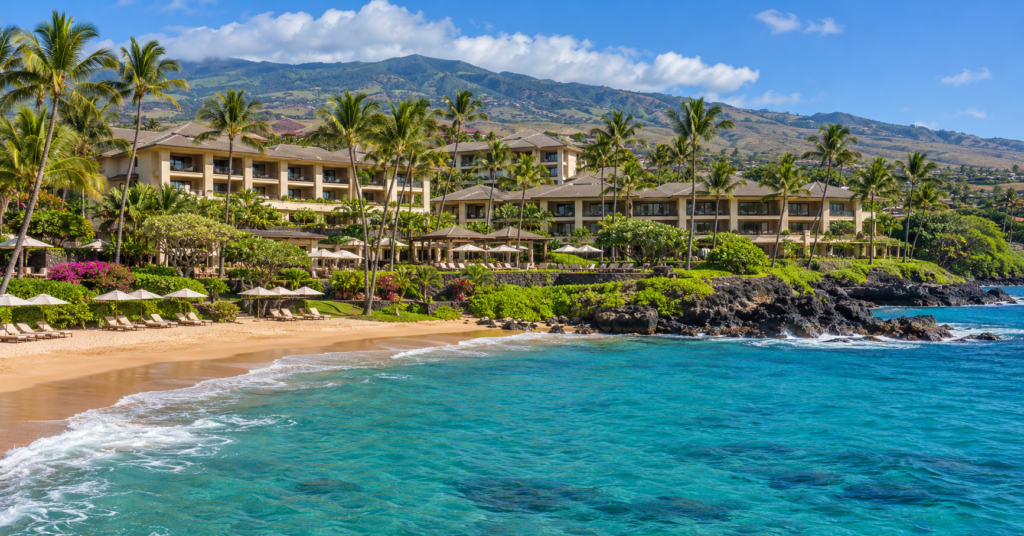
Four Seasons Resort Maui at Wailea operates at a different service level than most properties, and that shows up in ways that really matter to families. The staff-to-guest ratio is higher, which means faster responses, more flexibility, and better problem-solving when something goes wrong.
They’ll arrange childcare, help with equipment rental, manage special asks, and generally remove friction from your day. This becomes valuable when you’re dealing with complex logistics: multiple children at different ages, dietary restrictions, a grandparent with mobility concerns, or just the reality that family travel involves constant small adjustments.
Four Seasons staff are trained to anticipate needs and solve problems before you have to ask twice.
The resort also has strong family programming and excellent beach access. The pools are well designed for families, with areas suitable for different ages, and the beach here is one of Wailea’s best, with generally calm conditions and good snorkeling just offshore.
The property manages to feel luxurious without being stuffy, which is harder to achieve than it sounds.
Four Seasons is particularly well suited to families who want luxury but aren’t necessarily prioritizing a giant pool complex. You’re paying for service, location, and an overall experience as opposed to just physical infrastructure.
If you value having someone anticipate your needs, solve problems quickly, and make everything feel effective, that premium makes sense.
That said, Four Seasons is expensive even by Wailea standards, and families should check for any active renovation notices before committing to a non-refundable rate. Some recent reports mentioned accommodation updates with potential daytime noise, so you really want to confirm current property status before you book.
The last thing you need is to pay premium rates and then have construction noise during your toddler’s nap time.
Westin Maui and the Kāʻanapali Alternative
The Westin Maui Resort & Spa in Kāʻanapali appeals to families who want that active, bustling resort energy. The location is exceptionally convenient.
You’re steps from Whalers Village, which gives you shopping, casual dining, and entertainment without needing a car.
The beach is right there, the pools are family-oriented, and the property recently added Valley Alley, which includes bowling, arcade games, virtual reality, and Topgolf Swing Suites.
That last addition matters more than it might seem because it gives teenagers and older kids something to do that doesn’t feel like a kiddie pool. It also gives families an indoor option when the weather turns or when kids are just tired of swimming.
After three days of beach and pool, having bowling and arcade games available can be exactly what breaks up the routine and keeps everyone happy.
The Westin also runs a Keiki Club, though it’s fee-based, so you need to factor that into your budget. The overall vibe is active and social as opposed to quiet and intimate, which is perfect if that’s what you want but potentially overwhelming if you were hoping for calm.
You’ll see lots of families, the pool areas get busy, and there’s generally a lot happening at any given time.
Kāʻanapali in general is a strong choice for families who like having options, who want to walk to restaurants in the evening, and who enjoy that classic resort-strip atmosphere. It’s less polished than Wailea and less formal, and for many families that balance is exactly right.
You can walk to dinner in flip-flops without feeling underdressed, and there’s enough activity that kids always have something to look forward to.
Why Condos Outperform Hotels for Long Stays
If you’re staying seven nights or longer, the math and logistics start to favor condos pretty strongly. Properties like Honua Kai, Marriott’s Maui Ocean Club, and Westin Nanea offer full kitchens, in-unit laundry, multiple bedrooms, and living areas.
That changes your daily rhythm in ways that genuinely improve the vacation.
You can make pancakes for breakfast instead of paying seventy dollars at a resort restaurant. You can wash swimsuits and towels instead of packing fourteen outfits.
You can let kids eat an early dinner while adults cook something later.
You can pack lunches for the beach, deal with snacks without constantly buying them, and generally function more like a household than a hotel guest.
The trade-off is that housekeeping is usually limited, maybe once or twice during your stay instead of daily. Some families miss that service.
But in my experience, the ability to manage your own space, your own schedule, and your own food outweighs the housekeeping loss, especially once you’re past the first few days.
You establish routines, you know where everything is, and you’re not waiting for housekeeping to finish before you can go back to your room.
Honua Kai is a particularly smart choice for families who want condominium flexibility without sacrificing pool infrastructure. The property has large pool areas, it’s near a swimmable beach, and many units include everything you need for self-catering.
It’s not as service-intensive as a full luxury hotel, but for families with young children, that kitchen and that washer-dryer can be more valuable than turndown service.
Being able to wash a load of laundry every other day means you pack half as much, which makes the whole trip easier from the moment you leave home.
Matching Resorts to Children’s Ages
This is where most families get it wrong. They book based on overall reputation instead of thinking about their actual children’s ages, and the result is a mismatch between what the resort offers and what the kids can actually enjoy.
Babies and toddlers, roughly birth through age three, need shallow water, shade, easy room access, and logistical simplicity. They can’t use most slides, they won’t join in kids clubs, and they require frequent naps.
For this age group, Fairmont Kea Lani, Honua Kai, Marriott’s Maui Ocean Club, or Westin Nanea make the most sense because they provide space, kitchens, and flexibility.
What matters is having a place to prepare bottles, wash baby clothes, store snacks, and retreat for naps without everyone having to tiptoe around.
Preschoolers, roughly ages three to five, start to benefit from pool features, but they still need shallow areas and can’t always meet height requirements for major slides. They want to feel like they’re doing big kid stuff, but they still need safe environments and close supervision.
Grand Wailea, Wailea Beach Resort, and Hyatt Regency Maui work well here because they have family pools and gentler attractions alongside the bigger features.
Your four-year-old can play in the lazy river and splash in kid-friendly areas while older cousins hit the big slides.
Elementary-age kids, especially ages five through twelve, are the sweet spot for Grand Wailea, Westin Maui, Wailea Beach Resort, and Hyatt Regency Maui. These children can use most attractions, they enjoy structured activities, and they have the stamina for longer resort days.
This is when kids clubs, waterslides, and organized programming deliver the most value.
Your eight-year-old can spend half a day at the kids club making crafts and learning about Hawaiian culture while you actually relax by the pool.
Teenagers need something completely different. They’re not interested in kiddie pools, and they’re often too old for traditional kids clubs.
What works is resorts with sports, gaming, independence, and areas where they can socialize.
Westin Maui’s Valley Alley is a good example. So is a property that has beach access, water sports, and spaces where teenagers can exist without feeling like they’re stuck in a family resort.
Your fourteen-year-old doesn’t want to hang out with you all day, and that’s fine.
Having a bowling alley or game room where they can meet other teens makes everyone happier.
For multigenerational groups, grandparents, parents, and kids traveling together, you need enough space that everyone has privacy. Fairmont Kea Lani, Montage Kapalua Bay, Grand Wailea, and Honua Kai all offer configurations that can work, but you need to think carefully about room layouts and whether connecting rooms or a large villa makes more sense.
Sometimes two separate units work better than one large one, especially if the grandparents want their own kitchen and living space.
People Also Asked
What is the most family-friendly resort in Maui?
Grand Wailea is often considered the most family-friendly resort in Maui for families with elementary-age children, primarily because of its massive pool complex with multiple waterslides, a lazy river, and extensive kids programming. However, the best choice depends on your children’s ages.
Fairmont Kea Lani works better for families with babies and toddlers because every room is a suite with separate living areas.
Which side of Maui is best for families?
The south side in Wailea and the west side in Kāʻanapali are both excellent for families, but they offer different experiences. Wailea has calmer beaches, more upscale properties, and better year-round swimming conditions.
Kāʻanapali has more activity, easier walking access to restaurants and shops, and that classic resort-strip feel.
Families with very young children often prefer Wailea’s calmer beaches, while families with older kids might enjoy Kāʻanapali’s energy.
Does Maui have all-inclusive family resorts?
No, Maui does not have traditional all-inclusive resorts like you’d find in Mexico or the Caribbean. All Maui resorts require separate payment for meals, activities, and most amenities beyond basic room accommodations.
This is why having a kitchen becomes so valuable for cost control, especially for longer stays.
Some resorts include certain activities or kids club access, but comprehensive all-inclusive packages are not standard in Hawaii.
What is the best month to visit Maui with kids?
April, May, September, and October are often the best months for families visiting Maui. These shoulder season months offer better rates than peak summer and winter periods, smaller crowds, and generally good weather.
Ocean conditions are typically calmer than winter months, which matters for families with young children who want to swim safely.
School vacation schedules obviously affect when most families can travel, but if you have flexibility, these months provide the best value.
Is Wailea or Kāʻanapali better for toddlers?
Wailea is generally better for toddlers because the beaches tend to have calmer conditions, gentler waves, and better protection from strong currents. Properties like Fairmont Kea Lani in Wailea offer suite configurations that work really well with nap schedules and early bedtimes.
Kāʻanapali can have stronger shorebreak and more variable conditions, especially in winter.
That said, both areas have family-friendly properties, and resort pool quality matters more than location for many toddler-focused vacations.
How much should I budget per day for food in Maui?
Plan on roughly one hundred to one hundred fifty dollars per day for a family of four if you’re eating all meals at resort restaurants. Breakfast might run seventy to eighty dollars, lunch sixty to eighty dollars, and dinner one hundred fifty to two hundred dollars at nicer resort dining.
These costs add up quickly, which is why families staying a week or longer benefit enormously from having a kitchen.
You can cut food costs by fifty percent or more by making breakfasts and packing lunches while still eating dinner out.
Are Maui resort beaches private?
No, all beaches in Hawaii are public by law. Resort guests have convenient access through the property, but the actual beach is open to everyone.
This means your resort’s beach can be crowded, especially at popular properties in Wailea and Kāʻanapali.
Some resorts have better beach management and provide chairs, umbrellas, and towels only for guests, which creates a practical separation even though the sand itself is public.